
Autonomous networks need more than AI. They need trust.
AI can make decisions at machine speed, but it cannot compensate for an inaccurate view of the network. Learn why trusted network state, governance, and continuous validation are essential for operators to scale autonomy safely.
AI can decide. Trust determines whether it should act.
Every step toward autonomous networking requires operators to delegate more decision-making authority to automated systems. The critical question is not whether AI can act. It is whether operators can trust the network reality on which those actions are based.
Network operations leaders must support increasingly automated operations while remaining accountable for service reliability and customer experience. Before they delegate control to automated workflows or AI-driven decision engines, they need confidence that the network is operating as intended, every change stays within defined boundaries, and decisions are based on accurate and complete information.
Without that trust, automation can propagate errors at machine speed. The foundation of autonomous networking therefore requires more than advanced AI. It requires trust.
Automation multiplies the impact of bad information
Manual reviews, approvals, and operational checkpoints can slow execution, but they can also limit the reach of mistakes. In cloud-native and increasingly automated environments, empowered by a shared intelligence model, changes can move continuously across services, domains, and infrastructure. As execution accelerates, the consequences of an incorrect decision increase with it.
Consider the example of an automated workflow responding to an apparent capacity issue. If the underlying inventory or service relationships are incomplete, the workflow may optimize the wrong resource, disrupt a dependent service, or create an unintended downstream effect. The problem is not that the workflow acted too quickly. It is that it acted quickly on an incomplete view of the network.
This creates a paradox for operations leaders. The technologies that improve efficiency can also amplify inaccurate data, configuration drift, or policy violations. The constraint is often not the intelligence of the autonomous system, but the reliability of the operational information available to it.
As automation accelerates, the challenge becomes ensuring that decisions are grounded in an accurate understanding of network reality.
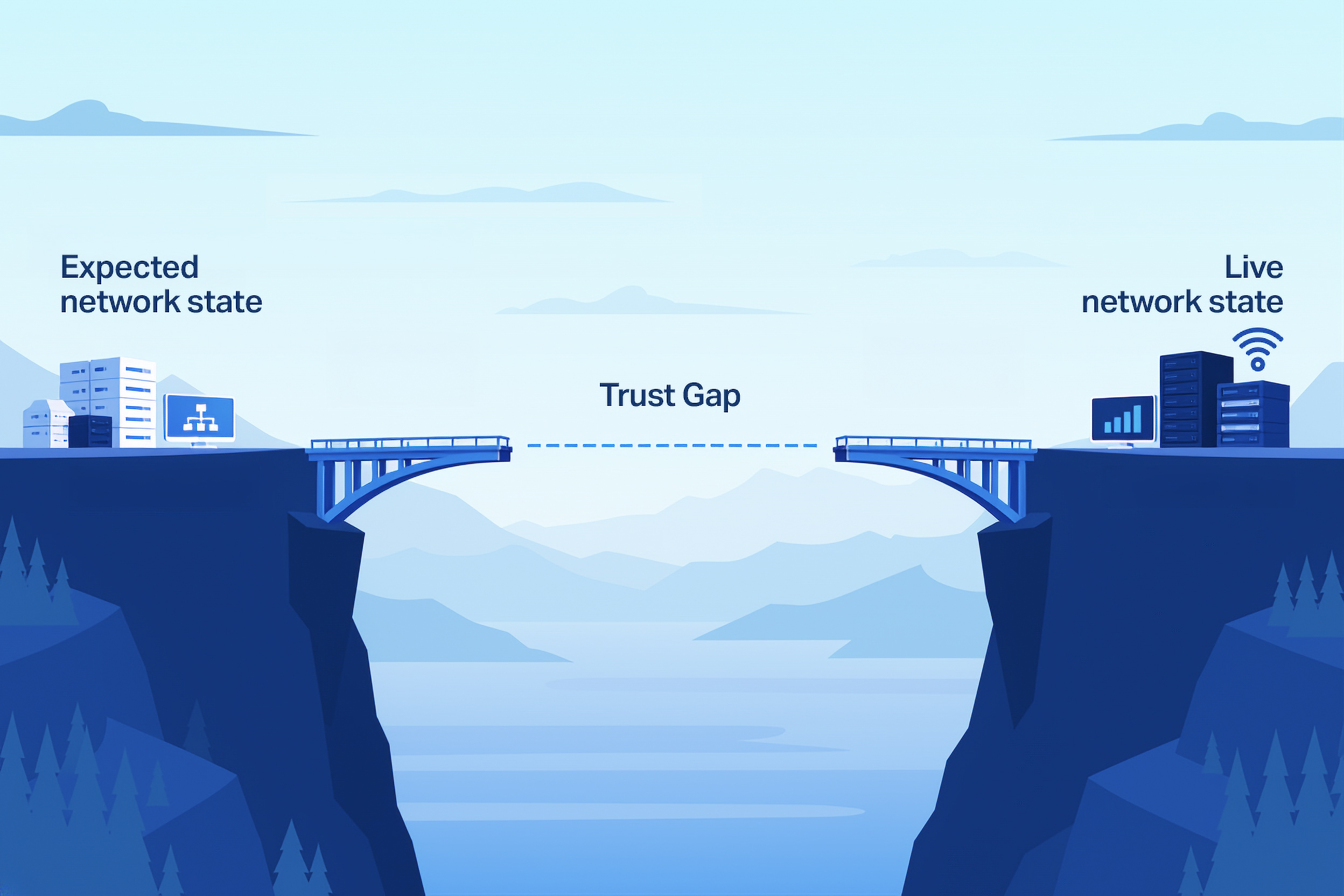
The Trust Gap separates assumed state from network reality
The Trust Gap is the distance between what operators believe about the network and its verified operational reality. As networks change, inventory can become fragmented, configurations can drift from their intended state, and operational data can lose accuracy. The result is uncertainty about whether automated decisions are grounded in network reality.
Visibility can show operators what is happening across the network, but visibility alone does not establish that the information is accurate, complete, current, and suitable for automated action. A visible network state becomes a trusted network state only when its accuracy can be continuously established, and changes can be governed and validated.
The wider the Trust Gap, the harder it becomes for operations leaders to delegate authority with confidence.
Autonomy requires trusted state, governance, and validation
Closing the Trust Gap requires three connected capabilities working together, which can be expressed in a simple equation:
Trust = Accuracy × Governance × Validation
Accuracy establishes a reliable view of the network and creates trusted state. Governance defines what is allowed. Continuous validation confirms that actions produce the intended result.
Weakness in any one area reduces trust in autonomous decision-making. Together, they provide the foundation for operators to delegate more authority safely, predictably, and at scale.
Let’s take a closer look at each capability.
Trusted state establishes what is true
Whether a decision is made by an operator, an automated workflow, or an AI agent, the outcome depends on the quality of the information available to it.
Accuracy establishes trusted state by giving operators confidence that decisions are grounded in an accurate and current view of the network. Acting on verified reality rather than assumptions reduces uncertainty, enabling people and automated systems to make decisions from the same trusted source of network reality.
Governance creates the boundaries autonomy requires
Knowing what is true is only part of the challenge. Autonomous systems must also understand what actions are permitted.
As networks become more autonomous, governance takes on a different role. Rather than relying on human review, it must increasingly be embedded in policies, permissions, and operational boundaries that automated systems can consistently apply.
The goal is to ensure that automated and AI-driven actions occur within trusted boundaries. Policies, configuration controls, auditability, and operational guardrails help ensure that decisions remain aligned with intended outcomes before risk is amplified. These safeguards allow autonomous systems to operate more consistently and predictably within defined operational limits.
This requires a shift from reviewing change after decisions are made to continuously guiding decisions as they are made.
Validation confirms the outcome
Trusted state establishes what is true, and governance defines what is allowed. Validation confirms that actions produce the intended result.
Continuous validation helps ensure that automated actions remain aligned with operational intent and deliver the expected outcome. Rather than assuming success, operators can continuously verify that network reality remains aligned with expectation.
Confidence determines how far autonomy can scale
Together, trusted state, governance, and validation create the confidence required for autonomous action:

This is not necessarily a rigid or one-time sequence. Each capability reinforces the next, while continuous validation feeds updated information back into trusted network state.
Solutions such as Blue Planet’s Configuration and Change Management help establish this operational foundation by bringing configuration and change under consistent governance, helping teams maintain trusted network state and manage change within defined operational boundaries
AI may make autonomous decisions possible, but trust determines how much authority operators can safely delegate.
Before expanding autonomy, assess the Trust Gap:
- How current is your network state?
- What boundaries govern automated action?
- How consistently can you validate the outcome?
The answers will determine not only how much automation you can deploy, but how much autonomy you can trust.