
Blue Planet named a Leader in IDC MarketScape. Why we think it matters.
Joe Cumello, SVP & GM at Blue Planet, discusses the meaning behind Blue Planet’s recognition in the IDC MarketScape and why we think it matters for communications service providers (CSPs) shaping their autonomous networking strategies.
Excerpt: “Blue Planet’s open, standards-based, vendor-agnostic architecture is a consistent differentiator, integrated in production with a wide range of network vendors. Customers highlighted Blue Planet as a foundational orchestration and inventory layer in large multisystem transformation programs, entrusted with consolidating complex legacy system environments” (IDC MarketScape).
Blue Planet was originally launched under the premise that CSPs were looking for a more open, less customized, less integration-dependent set of automation tools for their OSS. And while we all understand that every CSP environment is different and still requires some level of customization, we’ve largely stayed true to that mission. Even in the “AI/Autonomous Networks” age we find ourselves in today, our AI Studio democratizes the development of agents—allowing any party to build on top of the Blue Planet platform.
The obvious outcomes for our customers are empowerment, simplification, and reduced operational costs.
You don’t build a brand or a reputation by just saying things out loud. Blue Planet has lived its brand promise and executed in an open, programmable way for over 10 years. And that execution, of course, leads to trust and deep relationships with customers.
That's why the recognition of Blue Planet as a Leader in the IDC MarketScape: Worldwide Telecom Autonomous Network Operations Solutions 2026 Vendor Assessment is important to me. According to IDC, “This IDC MarketScape considers vendors’ OSS capabilities across the orchestration, assurance, and inventory required to support telcos to achieve higher levels of network autonomy.”
What makes this recognition meaningful isn't only that Blue Planet was named a Leader in autonomous network operations. It's why I believe our customers see us as a key player in large network transformations. I also believe IDC's independent analysis aligns closely with what our customers tell us about the challenges they're facing and the outcomes they're trying to achieve.
What the IDC MarketScape had to say
According to the report, “Blue Planet’s open, standards-based, vendor-agnostic architecture is a consistent differentiator, integrated in production with a wide range of network vendors…Blue Planet has also fostered a strategic and deep partner ecosystem and developed a promising roadmap for bringing agentic AI into its solutions and customer networks.”
At Blue Planet, our commitment to open, standards-based, multi-vendor environments has been central to our approach from the beginning. As CSPs modernize increasingly complex OSS ecosystems, they need solutions that work across existing technologies, vendors, and domains. This open foundation helps customers accelerate transformation while preserving flexibility and choice.
As part of the research, IDC interviewed customers directly. “Customers highlighted Blue Planet as a foundational orchestration and inventory layer in large multisystem transformation programs, entrusted with consolidating complex legacy system environments. Several customers also highlighted the responsiveness of its teams, stability and uptime of its assurance solution, and flexibility to tailor complex workflows to very different operational contexts. These provide the foundations for a programmable network layer and full digital twin to drive further network autonomy.” - IDC MarketScape
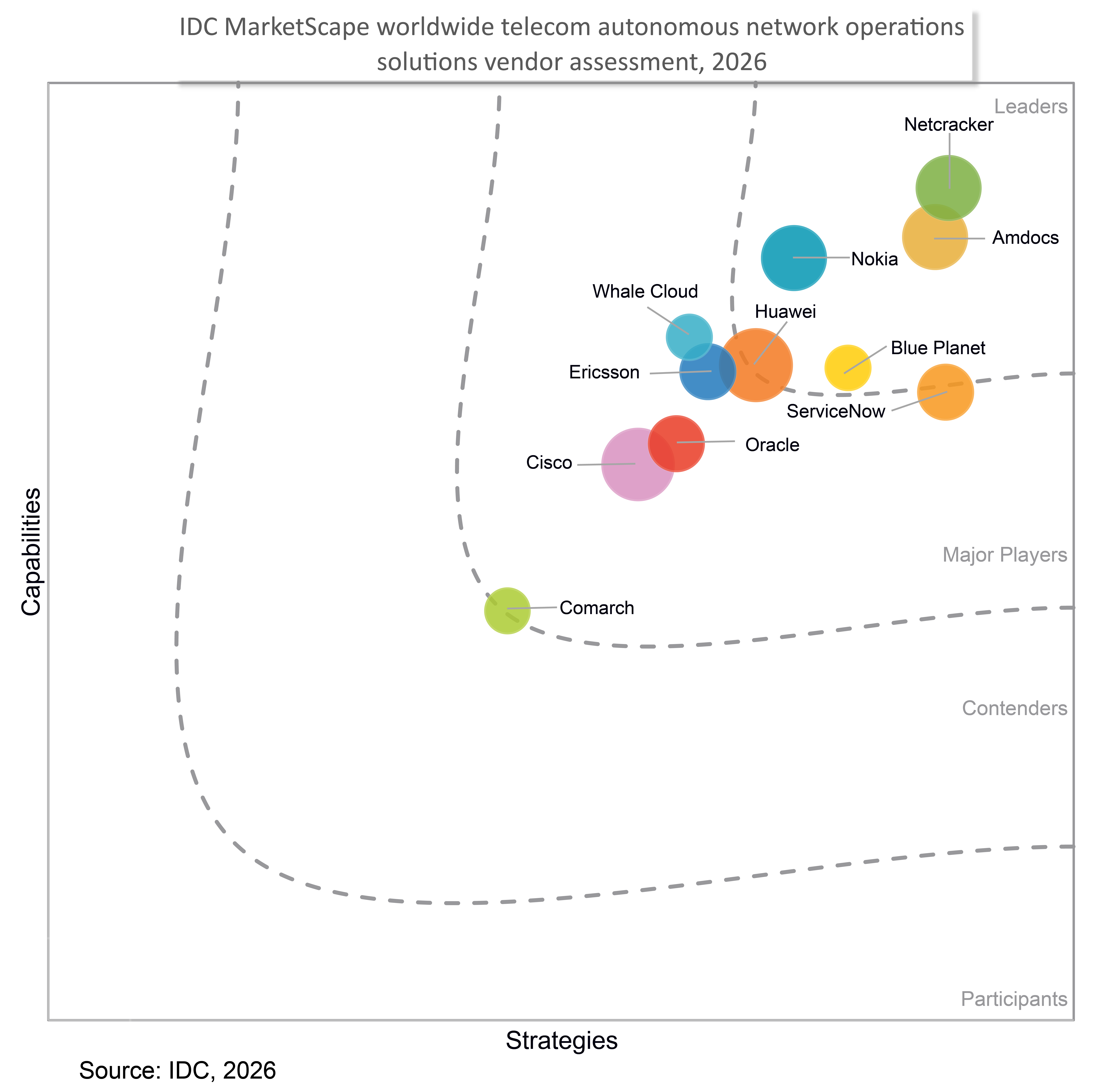
Source: “IDC MarketScape: Worldwide Telecom Autonomous Network Operations Solutions 2026 Vendor Assessment”, August 2026, IDC# US54129326
IDC MarketScape vendor analysis model is designed to provide an overview of the competitive fitness of technology and suppliers in a given market. The research methodology utilizes a rigorous scoring methodology based on both qualitative and quantitative criteria that results in a single graphical illustration of each supplier’s position within a given market. The Capabilities score measures supplier product, go-to-market and business execution in the short-term. The Strategy score measures alignment of supplier strategies with customer requirements in a 3-5-year timeframe. Supplier market share is represented by the size of the icons.
I believe the IDC MarketScape reinforces something I've long considered true: AI-driven autonomous networks can’t be created by simply adding AI on top of fragmented operations and unorganized data models. Autonomy demands a new approach, built on trusted and contextualized data, unified visibility across domains, open architectures, and operational processes that can scale. That's why we're focused on helping customers establish the operational foundation that enable practical automation today and support higher levels of autonomy tomorrow.
If you're evaluating your own autonomous networking strategy, I encourage you to read the IDC MarketScape vendor assessment.
Read the excerpt here.