From legacy OSS to autonomous networks: A practical path for Gulf service providers
Modernizing legacy operations support systems can help Gulf service providers deliver services faster and progress toward autonomous networks. Blue Planet’s Shady Salama details below.
Imagine an enterprise customer in the Gulf requesting more bandwidth. Delivering that simple change can still mean checking separate inventory systems, passing work between teams, and validating the service manually. For communications service providers (CSPs), the challenge is not just what they deliver, but how.
The constraint is often the operations support system (OSS). Fragmented inventory, disconnected workflows, and reactive assurance make it difficult to deliver services consistently across vendors and domains. Automating one step helps, but it does not remove the handoffs that slow the rest of the journey.
That is why OSS modernization matters. Connecting trusted data, service orchestration, assurance, and AI enables network operations, service fulfillment, and assurance teams to focus on customer needs instead of navigating disconnected systems.
For Gulf CSPs, the opportunity is to make faster activation, reliable service performance, and lower operational effort repeatable. Blue Planet helps build that foundation through open, cloud-native software designed for the journey toward autonomous networks.
The challenge is fragmented operations
Consider that bandwidth request again. Inventory must confirm available resources and service dependencies. Orchestration must coordinate the change across domains. Assurance must check that performance meets the customer’s service-level agreement (SLA). When these functions rely on fragmented data, even a routine change can become an exception.
A change in the optical layer can affect an IP service, while a configuration mismatch can trigger repeated alarms. When inventory, topology, and assurance data remain siloed, network operations and service assurance teams may resolve individual faults without seeing their impact on the end-to-end customer service. For capabilities such as Network-as-a-Service (NaaS), operators need a shared, service-level view that connects these domains.
That’s where connected OSS workflows can make a difference. Accurate inventory data helps validate network capacity, while multi-domain orchestration automates provisioning across network layers, replacing manual handoffs. The operational impact? Blue Planet reports that some customers have reduced service activation times by 80% through intent-based orchestration.
Additionally, AI can support OSS modernization, but its effectiveness depends on trusted operational data, well-defined workflows, and appropriate controls. Without these foundations in place, AI can amplify existing inconsistencies rather than resolve them.
Autonomy is an operating model, not a destination
Blue Planet’s approach treats autonomy as an evolution in how decisions are made. TM Forum’s Autonomous Network levels provide a framework for assessing progress. The near-term goal is not to remove people from operations. It is to improve how people and systems coordinate decisions across the network lifecycle.
In a more autonomous operating model, the network can interpret intent, assess current conditions, recommend or take bounded actions, and verify the result. Human supervision remains part of the model. The level of autonomy grows as data quality, process maturity, governance, and organizational trust improve.
For Gulf CSPs modernizing existing environments, that means improving operations without redesigning every system at once. Progress must be incremental, measurable, and aligned with business priorities.
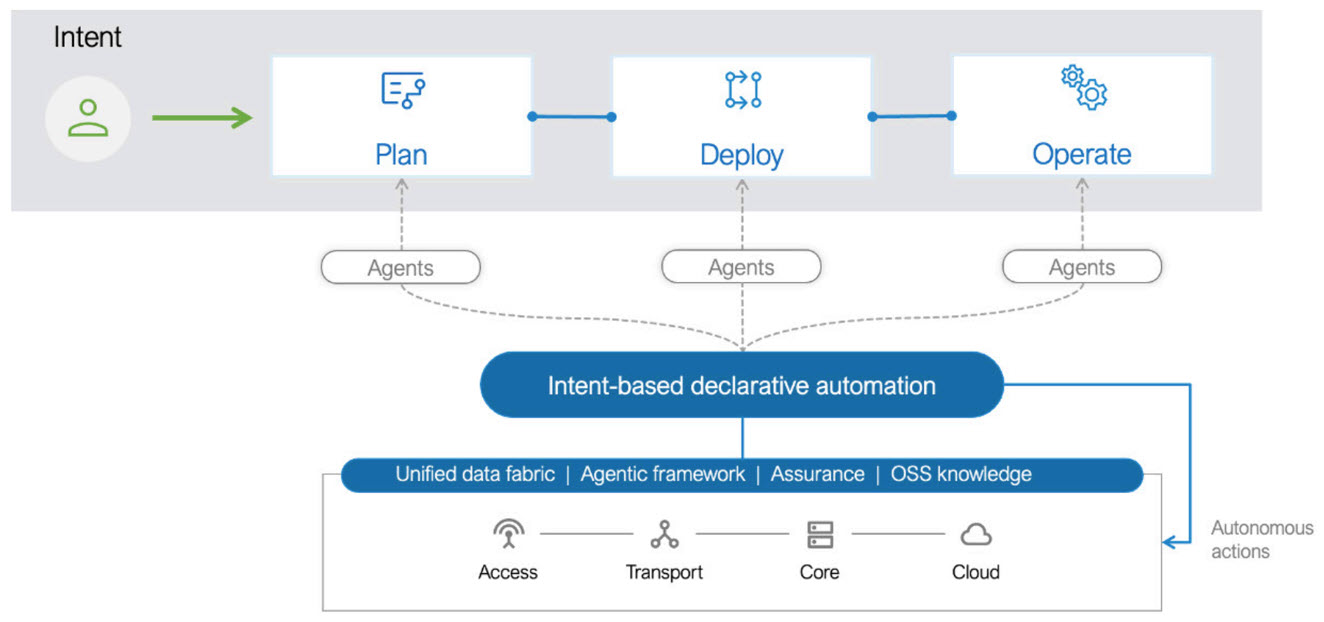
Figure 1: Intent and reconciliation across the network lifecycle
Four foundations for autonomous operations
- A trusted operational view: Planning, fulfillment, assurance, AI, and human operators need reliable information about resources, services, topology, customers, state, and performance. Inventory must become a dynamic operational foundation, enriched by contextual relationships rather than treated as a static record.
- Intent-driven coordination: Operators need a clear way to translate a business or service objective into actions across access, core, transport, and cloud domains. This reduces manual handoffs and supports faster, repeatable service delivery aligned with customer expectations.
- Proactive assurance: Device alarms alone do not explain customer impact. Operators need cross-domain observability and root cause analysis that connect network conditions to services and SLAs. Digital twin simulations can help assess the likely impact of changes before they are made.
- Governed agentic AI: AI agents need network context, approved tools, and access controls built into the OSS, with traceability and human oversight. Open interfaces allow operators to select large language models (LLMs) and integrate third-party agents without recreating closed operational silos.
What this means for Gulf service providers
For CSPs serving Gulf enterprise and public-sector customers, these capabilities can support four practical priorities.
- Governed service delivery: When an enterprise or public-sector customer sets specific service and control requirements, operations must apply them consistently. Policies, access controls, and traceable actions help teams understand what automation can do and when human approval is needed.
- Service resilience: A fault matters because of the services and customers it affects. Connecting assurance with inventory and digital twin insights helps operators assess impact, prioritize responses, and validate changes across network layers.
- Enterprise service growth: On-demand bandwidth, Network-as-a-Service (NaaS), and 5G network slicing depend on repeatable delivery and assurance. Open APIs and intent-driven orchestration help CSPs offer differentiated services without treating every request as a custom engineering project.
- Operational scale and skills: Growth should not require a proportional increase in manual effort. Automation must help domain experts remove repetitive work while retaining accountability for high-impact decisions.
A practical route forward
The strongest starting point is a measurable operational problem. Examples include inaccurate inventory, order fallout, slow root cause analysis, risky change validation, or capacity-planning delays.
The CC2 analyst report, From Automation to Autonomy: a Framework for Agentic AI-driven Network Operations, recommends aligning early agentic AI use cases with current automation maturity, data consolidation, modern OSS migration, and clear operational metrics.
Operators can establish a baseline, connect the relevant data, define guardrails, and introduce human-supervised automation. The next step is to measure service activation time, order fallout, or mean time to repair against that baseline. Successful use cases can then expand across services and domains.
This approach avoids two common mistakes. The first is treating autonomy as an all-at-once OSS replacement program. The second is deploying general-purpose AI without enough telecom context, operational control, or integration with existing OSS processes.
Ready to explore the path toward more autonomous network operations?
Discover Blue Planet resources, insights, and solutions designed to help service providers modernize operations and progress toward greater network autonomy.