
The three C's of AI trust
Trust is essential to advancing AI in network operations. Blue Planet's Peter Briscoe explores three key principles of AI trust and how they can help operators confidently accelerate AI adoption and autonomous networking.
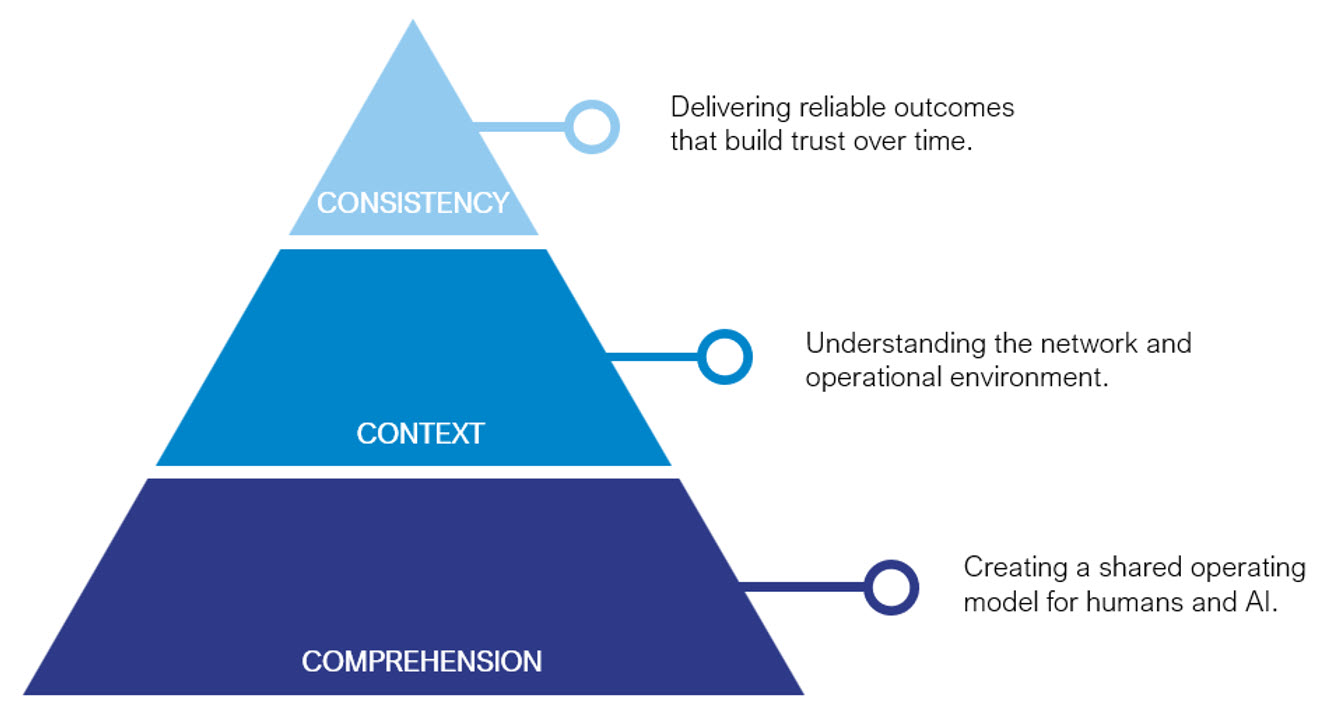
Trust in AI is built on three principles: comprehension, context, and consistency. Together, they create the foundation for putting AI to work in network operations, enabling faster decisions, greater operational resilience, and the confident acceleration of autonomous networking.
For telco network leaders, the challenge is no longer simply determining whether AI can generate useful recommendations. The more important question is whether those recommendations can be understood, governed, and trusted enough to act in live operational environments.
Through conversations with communications service providers (CSPs) around the world, I’ve come to see these three principles as essential to building that trust. They shape how people and AI agents work together, and how CSPs can move from experimenting with AI to confidently incorporating it into their networks.
Unlike trust between people, trust in AI doesn’t benefit from a personal relationship. It has to be earned differently: through observable behavior, consistent performance, and demonstratable outcomes.
Here's what each of these principles means in practice—and why they matter for network operators.
The first principle is comprehension. Understanding how AI works demystifies it so it can become something CSPs can question, guide, and govern. This does not require every operations specialist to become a data scientist, but it does require a working understanding of how AI systems use tokens, probability, training data, prompts, and context to generate responses.
Operations teams need structured learning programs that explain both the strengths and limitations of AI before autonomous network workflows can be trusted at scale. With the right understanding of how data influences AI-driven recommendations and decisions, teams will be better equipped to validate outcomes, identify potential risks, and confidently expand the use of automation across network operations.
Comprehension needs to evolve into a bidirectional understanding between the person and the AI agent, ensuring that each understands the role of the other. The human operator defines the intent, objectives, and guardrails, while the AI agent is empowered to undertake approved actions, with the ultimate accountability for outcomes remaining with the human operator.

The second principle is context. In any conversation, a shared understanding between participants not only simplifies the exchange, but it also builds trust. When both sides – both human operators and AI agents - understand a particular object or concept in the same way, the conversation moves faster and with less ambiguity. Even common terminology makes a significant difference: knowing precisely what is meant by an order, or understanding the distinction between activation and provisioning, can materially improve the quality and speed of an AI interaction.
It can be difficult to identify context gaps upfront when working with AI. An illustrative example of this is comes to mind through past experience. I asked an AI engine to create an image of a bridge over the river in Paris. The result did a good job of rendering the Eiffel Tower and the banks of the river, but it placed the bridge down the center of the river rather than connecting the two banks. Technically, the bridge was over the river, so the answer was not entirely incorrect. However, it missed the implicit context that a bridge over a river is expected to connect one bank to the other. These kinds of context gaps create partially correct outcomes, drive additional cycles of refinement, slow the process down, and ultimately diminish the value of AI.
This lack of context remains evident in many of the AI interactions we observe during customer tests. Creating a unified and federated data context is a critical first step that nearly all our customers have identified as essential. However, for CSPs, effective AI requires more than data federation alone. It must understand the network, the underlying technologies, and the operational processes that govern them. This domain awareness is critical not only to producing the right recommendations, but also to building trust in the recommendations and enabling more natural interactions with the users. When operators must spend time explaining the context, terminology, or intent behind a request, confidence in the resulting recommendation declines.
The third principle is consistency. Complex operational questions often have multiple valid answers, and the way a prompt is framed influences the recommendations provided. To build trust, AI systems must deliver responses that are consistent and traceable, while adapting to changes in network conditions and operational context. Trust is further strengthened when recommendations are linked to measurable outcomes, allowing operators to see a clear connection between AI-driven decisions and the results they produce, even as operational status changes. This can happen a lot in rapid operational environments when millions of data points are collected every minute.
Consistency improves when AI agents can share what they learn. Rather than making decisions in isolation, agents can build on successful outcomes and learn from mistakes across the operational environment. This shared learning helps improve the quality of recommendations over time, allowing AI to adapt more quickly to changing conditions while giving operators greater confidence in the actions it takes.

Turning trust into autonomous operations
The potential of autonomous operations for CSPs is significant. But realizing that potential requires more than capable AI. It requires putting comprehension, consistency, and context into practice within an operational framework CSPs can trust.
That framework is governance. Identity, permissions, policy enforcement, validation, and recovery provide the accountability and guardrails needed to translate trusted AI into action. Together, they give CSPs a path to embrace AI-driven decision-making while maintaining appropriate human oversight and moving confidently toward greater autonomy.
Learn more on our website.
