
From intent to revenue: How agentic AI unlocks scalable 5G network slicing
Blue Planet’s Carlos Estepa explores how agentic AI helps CSPs automate 5G slicing from request to activation and assurance, turning 5G slicing into a scalable revenue opportunity.
5G was never just about speed. It was about flexibility. The ability to create purpose-built services for very specific needs. A slice for a stadium event, a manufacturing plant, or a remote surgery. Each has its own performance profile and service guarantees.
In theory, network slicing makes this possible. In practice, delivering slices at scale has proven far more difficult. The technology exists, but turning that promise into reality requires a new way of operating the network.
For many communications service providers (CSPs), network slicing still involves too many manual steps, system handoffs, and guesswork. Designing, provisioning, and assuring thousands of dynamic slices across RAN, transport, and core domains is not just complex. It is commercially limiting.
This is where agentic AI changes the equation. Instead of treating each slice as a custom engineering project, AI agents can interpret the customer’s business intent, translate it into slice requirements, coordinate design and activation across radio access network (RAN), transport, and core domains, and continuously monitor performance against policy. With the right knowledge and context, agents can help automate the slice lifecycle from request to activation and assurance, making slicing operationally scalable instead of manually intensive.
When that happens, the timeline from customer request to revenue shrinks dramatically. In real-world 5G slicing deployments, Blue Planet has helped reduce slice activation from months to hours and lower slice order management costs by up to 80%, turning slicing from a technical capability into a scalable commercial model.
The real challenge: Quickly turning intent into action
Every slice starts with a business need, but in traditional environments, turning that need into a working service is anything but straightforward. Sales interprets the requirement, engineering defines the parameters, and operations configures multiple systems across disconnected tools. The process moves in stages, with handoffs at every step. That’s why something that should feel agile ends up feeling slow.
Intent-based networking offers a different path. Instead of asking customers to define latency targets or slice identifiers, you capture what they actually care about. For example: “We need a temporary slice for a three-hour remote robotic surgery trial with guaranteed ultra-low latency and high reliability.”
With Blue Planet AI Studio, operators can use AI agents to take that business intent and translate it into a structured, executable service design. The agents evaluate policy, available resources, service constraints, and domain requirements to generate feasible designs and viable configurations quickly and consistently. In a slicing context, this means the business request can be transformed into the service parameters, workflow steps, and orchestration actions needed to move from intent to activation.
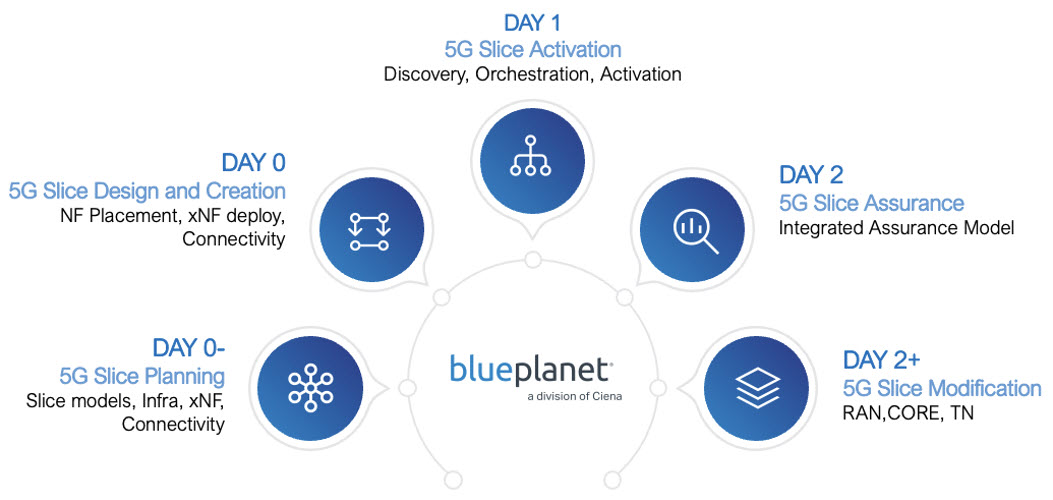
Figure 1: 5G slicing lifecycle
None of this works without accurate, trusted data. That’s why Blue Planet Inventory is foundational. By reconciling physical and virtual assets into a single, federated source of truth, it ensures that every AI-driven decision is grounded in reality: real capacity, topology, dependencies, and constraints.
Trust also requires control over how changes are made in the network. Blue Planet Configuration and Change Management (CCM) strengthens that trust by helping operators govern device configuration, change, and lifecycle management so automated actions can be executed with greater visibility, compliance, and confidence.
Orchestrating across domains without the silos
A 5G slice doesn’t live in one place. It spans the radio network, the transport layer, and the core. Historically, each of those domains has operated in its own management silo. Coordination happens, but often sequentially and manually.
Agentic AI introduces a more coordinated model. A supervisor agent interprets the intent and oversees the slice lifecycle. Specialist agents then work with Blue Planet Orchestration, to coordinate 5G slicing tasks across domains, such as allocating radio resources, provisioning transport paths, and coordinating core configurations. The important part is that these actions can happen in parallel with shared context, rather than through a chain of manual handoffs.
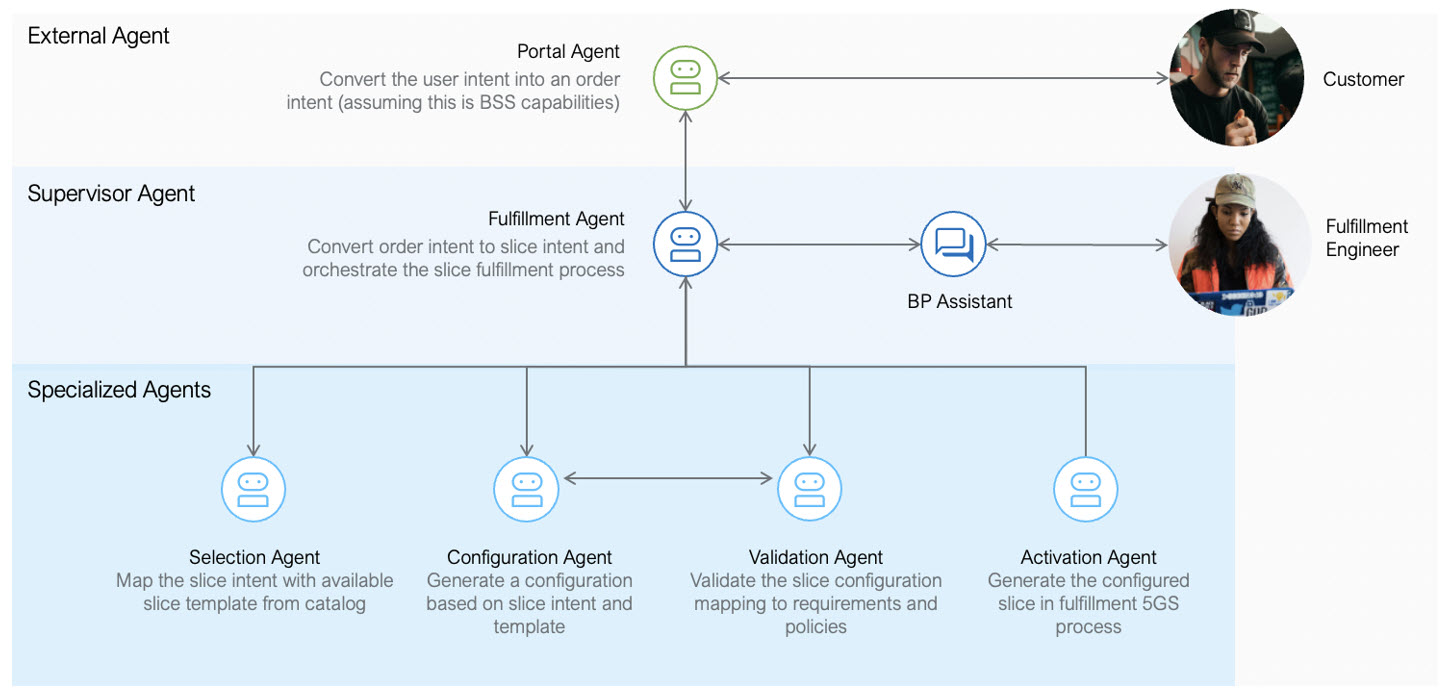
Figure 2: A team of agents automates the 5G slicing fulfillment process
Because Blue Planet’s architecture is open and cloud-native, this orchestration works across multi-vendor environments. Operators aren’t forced into proprietary stacks or rigid workflows. The result is faster, more consistent slice activation that supports 5G monetization at scale.
From reactive monitoring to proactive assurance
Launching a slice is one milestone. Maintaining it is another. Slices often carry strict service-level commitments. In traditional assurance models, issues are detected only after they begin to impact performance. Engineers respond, but customers may have already noticed.
Agentic AI enables something different: closed-loop assurance. Blue Planet Unified Assurance and Analytics provides the real-time service visibility AI agents need to monitor telemetry, performance metrics, utilization data, and SLA indicators across each slice. When patterns indicate a potential issue, the system can analyze conditions, evaluate available resources through the inventory foundation, and trigger orchestration workflows to rebalance or scale capacity. Just as importantly, it validates that performance has returned to policy-defined targets, protecting the service experience that premium slices depend on.
This isn’t about removing people from the process. It’s about giving operations teams an intelligent partner that works at machine speed and across domains, helping protect both SLAs and revenue.
Turning slicing into a business engine
For leadership teams, the real question is not whether slicing works. It is whether slicing pays off. Agentic AI helps unlock value in three tangible ways.
Faster concept-to-value
When provisioning moves from manual coordination to intent-driven automation, more service opportunities become commercially viable. Temporary events, enterprise pilots, and industry-specific offerings can be delivered quickly and predictably.
Operational efficiency
Reducing manual touchpoints across design, fulfillment, and assurance lowers operational friction. In multi-domain environments, that simplification can materially reduce fulfillment complexity and ongoing operational costs.
Confidence in differentiated services
With real-time visibility into performance and SLA compliance, operators can confidently support premium, outcome-based offerings. The network can evolve from a connectivity layer into a programmable service platform.
That’s when 5G slicing becomes more than a technical feature. It becomes a repeatable revenue lever: faster to launch, easier to assure, and practical to scale.
The path forward: From automation to autonomy
The shift to autonomous networking does not need to begin with a massive transformation program. It can begin with a focused decision: stop treating slicing as a technical experiment and start treating it as a scalable business capability.
Agentic AI makes that shift possible, but only when it’s grounded in the right foundation. You need:
- Trusted, reconciled inventory so decisions are based on reality.
- Open, multi-domain orchestration so intent can be executed consistently.
- Governed change management so every automated action is visible, controlled, and trusted.
- Closed-loop assurance so performance is continuously validated.
- A secure, governed AI framework so intelligence operates inside the OSS, not around it.
That’s the approach Blue Planet brings together. When the network can understand business intent, act on it in real time, and continuously validate the result, slicing stops being operationally complex. It becomes commercially repeatable. That is how 5G slicing moves from intent to revenue.