
Operationalizing 5G dynamic slicing with Blue Planet and P.I. Works
Blue Planet and P.I. Works bring complementary capabilities to help mobile network operators (MNOs) move 5G slicing from technical capability to operational service model, connecting multi-domain service orchestration with Radio Access Network (RAN) automation and assurance across the slice lifecycle.
5G slicing will not be monetized by creating more slices. It will be monetized by operating slices as dynamic, SLA-backed services that can be activated, assured, modified, and optimized with confidence.
Most operators already know this. The question is how to get there.
The opportunity is significant. ABI Research forecasts total slicing revenue will reach US$67 billion by 2030, with US$43 billion estimated to be enterprise-driven. But the market is still early: Heavy Reading, now part of Omdia, found in its 2025 5G Core Operator Survey that 11% of operators had deployed their first slicing use case, while another 15% had started implementation and testing. The path from early use cases to scaled monetization depends on orchestration, lifecycle automation, and integration with BSS/OSS.
That is where Blue Planet and P.I. Works bring complementary value: connecting multi-domain service orchestration with RAN automation and assurance so MNOs can manage slices as governed, SLA-aware services across real-world, multi-vendor networks.
The goal is clear: deliver differentiated connectivity over shared infrastructure and open new commercial opportunities across enterprise, industrial, and public sector markets. The challenge is not the slicing concept itself. It is operationalizing it: activating a slice in the right place, at the right moment, with the right service guarantees, without disrupting service for everyone else using those cells.
The operational challenge behind dynamic slicing
Take a realistic scenario. A new service must go live in a specific geographic area: an emergency response network, a temporary media event, or a private enterprise deployment. The MNO needs to know what is being requested, where it needs to run, what performance it must deliver, and whether the network can absorb it without degrading the existing mobile experience.
That last condition is harder than it sounds.
The radio environment shifts constantly, by cell, by location, by time of day, by user density, by interference, and by service demand. A requested service might be feasible in one part of a coverage area and constrained in another. Some cells qualify. Others do not. Activation logic alone cannot tell you which ones, or what to do about the ones that do not.
Dynamic RAN slicing needs feasibility analysis, policy control, resource awareness, configuration validation, and continuous assurance. But assurance alone is not enough. MNOs also need closed-loop optimization so the slice can adapt when network conditions change, performance degrades, or service requirements shift. And all of that has to connect to a service orchestration model that governs the broader lifecycle.
Why orchestration and RAN automation have to work together
Two automation layers are required, and neither can do the other’s job. The service orchestration layer is where intent gets defined, SLA requirements get translated into actions, and policy gets applied across domains. It governs what is being requested, where it should run, and what rules hold for the life of that slice.
The RAN automation and assurance layer is where the radio network not only answers whether any of that is actually possible, but also provides RAN-specific AI-driven closed-loop optimization. Which cells qualify? Are the resources available right now? Are configurations applied correctly? Is the RAN slice still meeting its SLA three hours after activation? Can the existing congestion problem be solved by optimization action, or do slice SLAs need to be adjusted?
A service orchestration platform without visibility into the RAN knows what the business wants, but it cannot tell you whether the radio network can deliver the service in a specific cell at 6 p.m. on a Friday. A RAN automation system without service orchestration understands radio resources, but it lacks the broader end-to-end service context, the customer SLA, and the lifecycle logic needed to know what a degradation signal should trigger.
The boundary matters. Service intent and cross-domain lifecycle control belong at the orchestration layer. RAN slice lifecycle, feasibility, execution, and assurance belong in the radio access network. When these layers work together, MNOs can move beyond one-time activation toward closed-loop service automation across the slice lifecycle.
A practical model for SLA-backed slicing
Operationalizing 5G slicing requires a coordinated model between service orchestration and RAN automation.
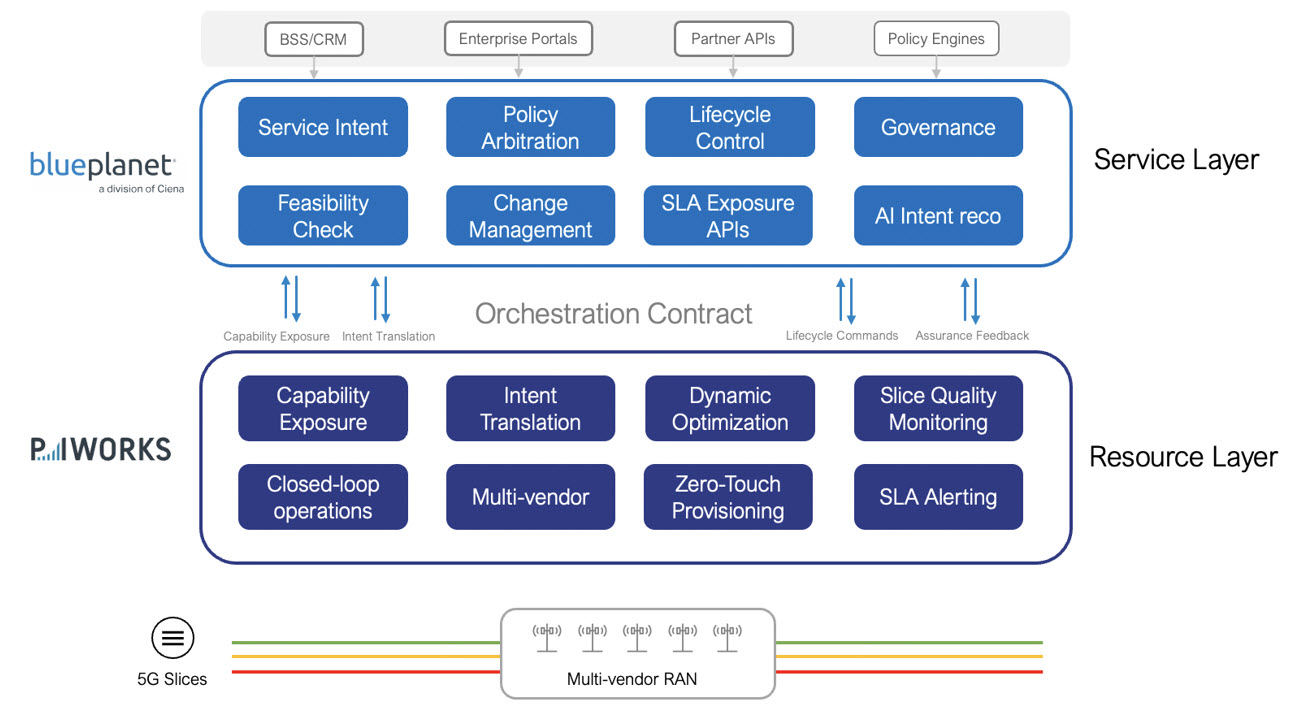
Blue Planet handles the service layer required to manage slices across domains (mobile and fixed), including:
- Service intent
- Lifecycle control
- Policy arbitration
- SLA exposure
- Change management
- End-to-end coordination
With Blue Planet, an MNO can understand which RAN slice maps to which service, how that slice fits into the broader service lifecycle, and whether service or assurance information should trigger a lifecycle action.
P.I. Works handles the unified RAN resource layer for all major RAN network equipment providers (NEPs), including:
- Automated RAN slice instantiation, maintenance and deinstantiation
- RAN Policy management
- Dynamic RAN slice observability
- RAN slice resource management
- Configuration validation
- Capability exposure
- RAN slice assurance and optimization
In a coordinated slicing architecture, these capabilities help determine whether the RAN has the coverage, capacity, and conditions to support what is being requested in a defined area, then connect that RAN-level context back to the service lifecycle.
This is why open coordination matters. MNOs are unlikely to operationalize slicing through a single monolithic stack. Multi-vendor environments need architectures with well-defined interfaces between the service orchestration layer and the RAN. That is not just a design preference; it is an operational requirement.
What MNOs gain by operationalizing 5G slicing
For MNOs, the value of 5G slicing is not just in creating differentiated services. It is in making those services repeatable, reliable, and commercially scalable across the full lifecycle: creation, activation, assurance, modification, and termination.
Blue Planet and P.I. Works bring complementary capabilities that can help MNOs address this operational challenge. P.I. Works brings the RAN automation and assurance capabilities needed to understand radio conditions, expose RAN capabilities, validate configuration, and assure slice performance. Blue Planet brings the multi-domain service orchestration needed to connect that RAN context to service intent, policy, SLA exposure, lifecycle control, and cross-domain coordination.
Together, these capabilities help MNOs move from isolated slice activation to governed slice lifecycle automation. That means they can respond faster to enterprise and mission-critical service opportunities, reduce manual effort in slice order management, and operate slices with greater confidence across RAN, core, and transport domains.
The business impact is significant. With the right operational model, MNOs can reduce fulfillment time for new slice orders from weeks to hours, lower slice order management costs by up to 80% using agentic AI-driven automation, and simplify end-to-end slice lifecycle automation so services can be planned, activated, assured, modified, and eventually terminated with less operational risk.
This is what makes 5G slicing monetization real. MNOs do not just need more slicing features. They need the operational discipline and automation to deliver slices as SLA-backed services consistently, efficiently, and at scale.
For more information, visit Blue Planet and P.I. Works.